
20% faster cycles. No PPAP. No tooling changes.
A military-grade mold-insulation breakthrough — 5 years of partnership with STS, 100+ installations, 100M+ parts produced, zero failures — no budget, no risk. Applied to PC, ABS, PA, PP, HDPE, TPO, TPE, TPU across 300–4,500 ton machines.
Four numbers that define the technology.
More parts per hour from the same press, same tool.
Lower mold temp → less energy → fewer emissions per part.
Pre-negotiated with your supplier before the workshop — shared savings model.
No upfront cost, no retooling capital, no PPAP requalification. CSC is paid only from verified savings.
Cooling drives 50–70% of injection cycle time. Most of it is waste.
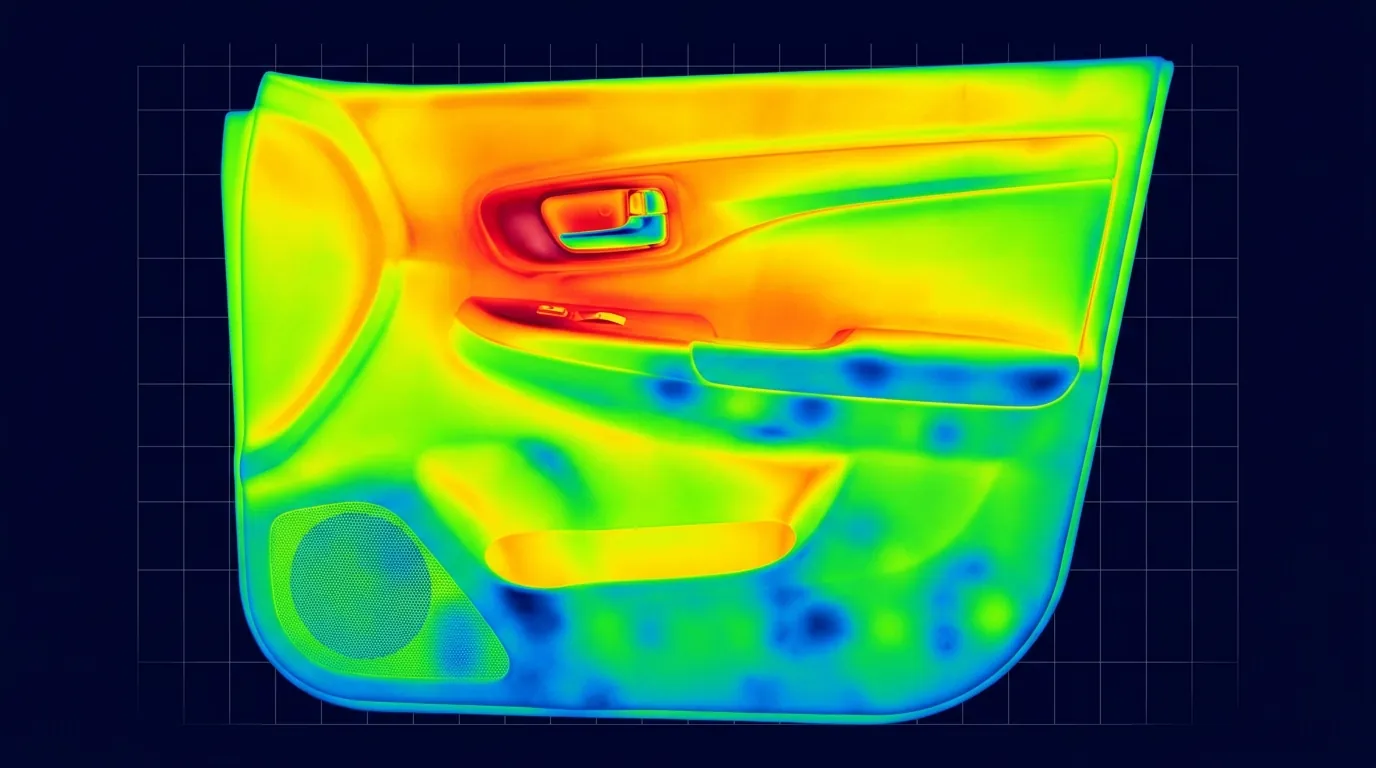
Without insulation, hot & cold zones force overheating.
Without a thermal barrier between manifold and tool, your mold develops cold spots — and the press compensates by running 70°F hotter than melt temperature. That extra heat stays trapped in the part and tool, extending cooling time and burning energy.
- ✗ Operating temp 450°F instead of 380°F
- ✗ Cooling time pushed from 20s → 30s+
- ✗ Higher energy draw on every shot
- ✗ Aggressive thermal cycling kills tool life
30 years of attempted fixes failed.
Engineers have known the problem for decades. Asbestos was the original approach — banned for being carcinogenic. Ceramic boards came next — too rigid, not durable, impractical at scale. Then nothing for 30 years.
Survives 2000°F. Lasts the life of the tool. Enables fast changeovers. CSC partnered with STS to bring it to industrial manufacturing.
Apply insulation. Lower mold temp. Faster cycles.
A thermal barrier between the manifold and the tool lets the mold run cooler and more evenly — so there's far less heat to remove on every shot, and cooling (50–70% of the cycle) drops sharply.
Apply insulation between manifold and tool
Thermal barrier eliminates cold spots so the entire mold runs at a consistent, lower temperature. Done on-press during a normal changeover.
Lower mold temp 450°F → 380°F
Less heat to put in. Ejection temperature stays at 200°F (unchanged) — but there's less heat in the part and tool to remove.
Cooling time 30s → 20s. Cycle 53s → 43s.
~20% faster cycle, ~20% less energy, ~20% less CO₂. Part quality unchanged. No PPAP. No tooling changes.
A thermal shield between manifold and tool.
The insulation sits directly under the hot-runner manifold, blocking heat from soaking into the tool steel. The mold runs cooler and more evenly — so there's less heat to pull back out on every shot. It survives 2000°F, lasts the life of the tool, and installs during a normal changeover: no PPAP, no tooling changes.

Recent: Stellantis door module. Jeep Grand Cherokee at scale.
Stellantis — Door Module
Automotive door module at a Tier 2 supplier in the Chicago area. Tier 1 sponsored the work; CSC ran the workshop on a 610-ton hydraulic Toshiba press with the panel-design tool.
Temperature stepped down progressively across both workshop days: 465 → 440 → 420 → 410 → 400 → 390 → 380 final. Cool time alone fell from 19.4s to 13.3s.
Jeep Grand Cherokee — 4-year impact
1100-ton hydraulic press, natural-gas powered facility, 620,540 units/year. After mold insulation: faster cycles, more parts per hour, dramatic CO₂ reduction over the model's run.
“We got 18% cycle time reduction without changing a single mold or machine.”
“It helped me generate additional savings of ~10% with my suppliers.”
If you mold any of these, almost certainly yes.
Materials we’ve proven
- · PC (polycarbonate)
- · ABS
- · PA (nylon)
- · PP (polypropylene)
- · HDPE
- · TPO, TPE, TPU
- · Glass-filled grades
Excluded: thermosets.
Press range
- · Minimum: 300 tons
- · Preferred: 500+ tons
- · Max: 4,500+ tons (no upper limit)
- · Higher volumes = better economics
- · Multiple cavities are fine
Bigger machines, larger parts, more volume — all amplify the savings.
Applications
- · Interior trim (dash, door, console)
- · Exterior (bumpers, grilles, side panels)
- · Under-hood (intake, air boxes, fan shrouds)
- · Lighting, battery, seating, door modules
- · Consumer, packaging, medical, power tools
- · See how we size the savings ↓
~55 molded parts per vehicle are candidates.
When we screen a vehicle program, these are the injection-molded parts we look at first — exterior, interior and under-hood. Not every part makes the cut; the business case decides which ones do.
Exterior
- · Front bumper cover
- · Rear bumper cover
- · Headlamp housings / lenses
- · Tail lamp housings / lenses
- · Exterior mirror housings
- · Windshield cowl panel
- · Wheel arch cladding & trim
- · Main radiator grille
- · Roof rail mount covers
- · Front bumper lower skid plate
- · Rear bumper diffuser / skid plate
- · Water deflector cowl
Interior
- · Dashboard AC vents
- · HVAC air ducts
- · Door card substrates
- · Door map pockets / bins
- · A-, B-, C- & D-pillar trims
- · Scuff plates / sill guards
- · Instrument panel carrier
- · Dashboard upper structure & lower trim
- · Instrument cluster & infotainment bezels
- · Center console body, side trims & armrest base
- · Console storage bins & front storage
- · Wireless charger tray
- · Overhead console housing
- · Seat side valance & seat back shell
- · Interior tailgate panel
- · Cargo / 3rd-row side trims & trunk scuff trim
- · Lower sill loading panel
- · Glove box door & bin
- · Steering column cowl
Under-hood & powertrain
- · Engine splash shield
- · Engine beauty top cover
- · Fuse box housing
- · Composite engine oil pan
- · Air filter upper & lower box
- · Battery tray & box
- · Radiator fan shroud & impeller
- · Trunk load floor structure
- · Inner wheel arch liners
- · Luggage compartment side pockets
An OEM-wide business case, built before anyone touches a press.
We model the savings across your whole vehicle portfolio first, using public production data and CSC’s own cost benchmarks. Then we filter down to the models and parts that carry the value, so the pilot starts where the money is.
Programs, volumes and part lists collected entirely from verified, publicly available sources. No data request needed to get started.
Machine and plant burden rates factored from CSC’s open-book benchmarks and current market data.
Calculated from the latest region-specific market rates, so Europe and North America are each costed on their own terms.
We use a 15% cycle-time gain in the model, below the up to 20% we see in production.
~$51M (€44M) a year in savings potential.
Consolidated annual run-rate across both regions’ production networks, at volumes from 2027 onward.
Two filters: models first, then parts.
We rank vehicle models by savings, keep the ones that carry the bulk of the value, then rank the parts inside those models the same way.
All vehicle models
- 12 vehicle models
- ~2.2M vehicles / yr
- ~55 parts per vehicle
- 672 tools
Top 8 models
- 8 vehicle models
- ~1.6M vehicles / yr
- ~55 parts per vehicle
- 340 tools
Top 31 parts in those 8 models
- 8 vehicle models
- ~1.6M vehicles / yr
- ~31 parts per vehicle
- 223 tools
All vehicle models
- 6 vehicle models
- ~600k vehicles / yr
- ~55 parts per vehicle
- 271 tools
Top 3 models
- 3 vehicle models
- ~303k vehicles / yr
- ~55 parts per vehicle
- 136 tools
Top 18 parts in those 3 models
- 3 vehicle models
- ~303k vehicles / yr
- ~18 parts per vehicle
- 42 tools
Figures are annual savings potential at a 15% cycle-time gain. OEM anonymised.
No upfront cost. No risk. We share the savings, then you keep them.
- No upfront cost for the customer or the supplier.
- No-risk implementation for either side.
- CSC is paid only when the workshop and negotiations succeed.
- CSC shares 50% of the savings for 12 months.
- After that, 100% of the savings go to the customer.
- Introduces the technology and runs workshops with your suppliers or your own molding plants.
- Builds the business cases that pick the right parts.
- Pre-negotiates before the workshop, typically 3–12% off sell price.
- Completes the negotiations after the workshop.
- Supports the supplier if a PPAP is needed.
- Comes with an open mind.
- Embraces continuous improvement.
- Allows cycle time and CO₂ to be reduced by ~15%.
From NDA to workshop: two gates, then go.
Every part has to clear two milestones before anyone schedules press time: a positive business case and technical feasibility.
NDAs signed. We identify candidate parts and molds.
Supplier CBDs feed the business case evaluation.
If not, we pick a different set of parts and run it again.
We introduce mold insulation to the supplier and review the mold CAD.
If the insulation can’t be installed on that tool, the part drops out.
Savings agreed up front against 12% / 15% / 18% scenarios.
Scheduling, pre-workshop prep, then the on-press workshop.
Results documented and negotiations closed.
From desk study to scale: the 4-phase rollout.
Pilot
Pick 2–3 parts. Prove the technology and capture the financial + capacity benefit. Internal: plant + ops + tooling eng. Supply base: buyers + tooling eng.
Plan at scale
Each plant manager identifies high-impact parts. Business cases developed, technical feasibility confirmed, 2026 savings budgets estimated.
Implement at scale
Global lead PM identified. Timelines, savings tracking, budgets in place. Projects launched and tracked across plants.
Future-proof
Tooling specs updated to include mold insulation and 10mm tolerancing. Future product costed at the lower structure — wins new business.
| Applicable spend | Low (5%) | Mid (8%) | High (12%) |
|---|---|---|---|
| $10M | $500,000 | $800,000 | $1,200,000 |
| $20M | $1,000,000 | $1,600,000 | $2,400,000 |
| $30M | $1,500,000 | $2,400,000 | $3,600,000 |
Real-world average is ~8% to sell price across the network. CSC is paid only from the verified savings — no upfront fee.